
Colorado wool producers make a comeback
Loma sheep rancher Julie Hansmire enjoyed watching the televised 2026 Winter Olympics held in Italy in early February. She was especially excited to see the clothing worn by Team USA during the opening and closing ceremonies — the athletes were decked out in coats, pants, sweaters, mittens, and hats made from wool harvested from her ewes and nine other family ranches in the western United States.
Ernie Etchart, a second-generation Basque sheep rancher near Montrose, also looked forward to watching this year’s Olympics. “I’ve seen the uniforms — they’re gorgeous,” Etchart said. “It’s our claim to fame.” Like Hansmire, Etchart Livestock sells its wool to Shaniko Wool Company — the leading U.S. source for wool certified under the Responsible Wool Standard that ensures responsible land management, as well as ethical treatment of both animals and workers.
Oregon rancher Jeanne Carver founded Shaniko Wool Company in 2018 in response to the declining wool and textile industries in the United States. Carver’s family has raised cattle and sheep at its Imperial Stock Ranch in Oregon since 1871. For 100 years, the family sold their wool to the same processing warehouse — until 1999, when Carver’s longtime buyer told her they were closing and moving offshore, “like everyone else,” Carver commented.
“We could not sell our wool, nor could our neighbors,” Carver said. “Many of our neighbors sold their sheep.” Many regional mills where ranchers would take their fleece to be cleaned and processed closed. “America used to be the largest wool producing country in the world. I’ve seen tens of thousands of sheep producers go out of business due to the decline of textile manufacturing in the U.S. The industry has diminished significantly, and the sheep industry alongside it.”
With no buyer for her fleece, Carver and her late husband Dan came up with another plan for their wool that involved washing, carding, spinning, and dyeing the fiber to make their own yarn. Within a year they had placed their yarns in stores, eventually growing to hundreds of stores nationwide. “I was building a brand, a new business,” she said.
Then, in 2012, Carver received a call from Ralph Lauren — a widely known fashion and lifestyle brand and a U.S. Olympic team sponsor and outfitter. The New York City-based company was searching for a domestic wool provider. Six months later, Carver received her largest yarn order ever — which Ralph Lauren used to produce the Team USA uniforms for the 2014 Winter Olympics. “Ralph Lauren bought our wool and told our story,” she said. “It changed our life; our business exploded.”
Shaniko also provided the wool for Team USA during the Winter Olympics in 2018 and 2022 and for the Summer Olympics in Paris in 2024.
One year after the Ralph Lauren call, Patagonia — an outdoor gear and clothing company with sustainability goals that include eliminating nonrecycled or virgin synthetic fibers made from petroleum — contacted Carver regarding her wool. Patagonia was involved with creating a new, third-party audited global certification called Responsible Wool Standard. Carver’s family already practiced responsible, sustainable ranching, so it wasn’t much of a leap to become RWS-certified, the leading world standard for sheep and wool production, developed by Textile Exchange.
In 2016, the Carver family’s Imperial Stock Ranch became the first to be RWS-certified. “We looked at this as an opportunity to showcase good agricultural practices,” Carver said. “Certification can be an advantage in the market, giving brands confidence on how we treat the land and animals.”
As more companies began requesting her certified wool, Carver launched Shaniko Wool Company to scale the amount of certified wool being raised in the United States, and to help U.S. sheep ranchers who are RWS-certified remain competitive in the global market. “I buy all of their wool at a premium,” Carver said. “They get the highest prices for their wool in America.” Carver then sells the wool to Ralph Lauren and other brands seeking fiber grown responsibly. Shaniko wool is also certified to the Nativa Regenerative and Authentico standards.
Carver began by contacting the regional wool warehouse manager at Utah Wool Marketing in Salt Lake City to see if he knew other ranchers who might be interested in partnering with Shaniko. The manager referred Carver to a Basque sheep ranching family in Nevada who recognized the importance of what Carver was doing for the wool industry. His became the first ranch to join Shaniko. He brought in a second ranch and then introduced Carver to Hansmire — the third ranch to partner with Shaniko.
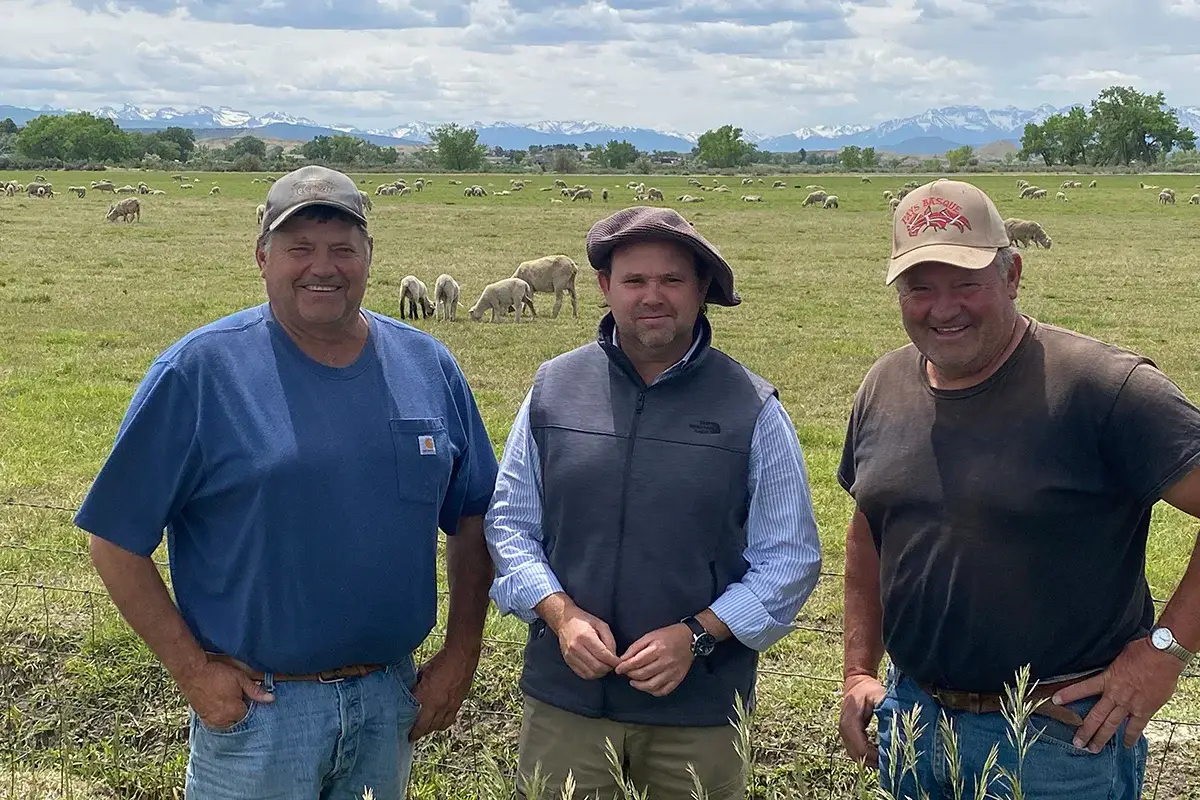
Etchart Livestock ranch in Montrose. From left to right: Ernie Etchart, Control Union Auditor Guzman Vergara, and George Etchart, photo courtesy Shaniko Wool Company.
“I spend at least three days with each ranch after a number of conversations before they become a member,” Carver said. “We get to know each other, and I get to see their operation — the land, facility, workers. We decide if it’s a good fit for everybody.”
In January, Shaniko had 10 farm partners, with six in Colorado, including farm partners in Rio Blanco County and two near the towns of Mack and Craig. This spring, Carver plans to add four to six additional farm partners, some of them in Colorado, she said.
Carver visits her farm partners at least once each year to do her own audit and then again to accompany a third-party auditor, who looks over the entire operation. Carver’s 10 ranching partners are like family to her, she said. “They are great examples of family agriculture in this country,” she said. “They’re passionate about ranching and being excellent land stewards. They love the culture, the animals.”
Hansmire grew up on a farm in Nebraska and married into a ranching family from Norwood. Her late husband Randy Campbell managed a sheep ranch and ended up buying the ewes after the owner retired. Hansmire continues to raise 3,200 Merino sheep, with the help of three to five hired herders throughout the year.
While ranchers in general don’t like people telling them what to do, becoming RWS-certified made sense, said Hansmire, who was already using best practices regarding land stewardship and the welfare of both her animals and her sheepherders, one of whom has worked for Hansmire for 25 years. Hansmire studied range science in college, with an interest in native plants, shrubs, perennial grasses, and land management. “Our biggest question every day is: ‘What is good for the soil? What’s good for the plants?’” she said.
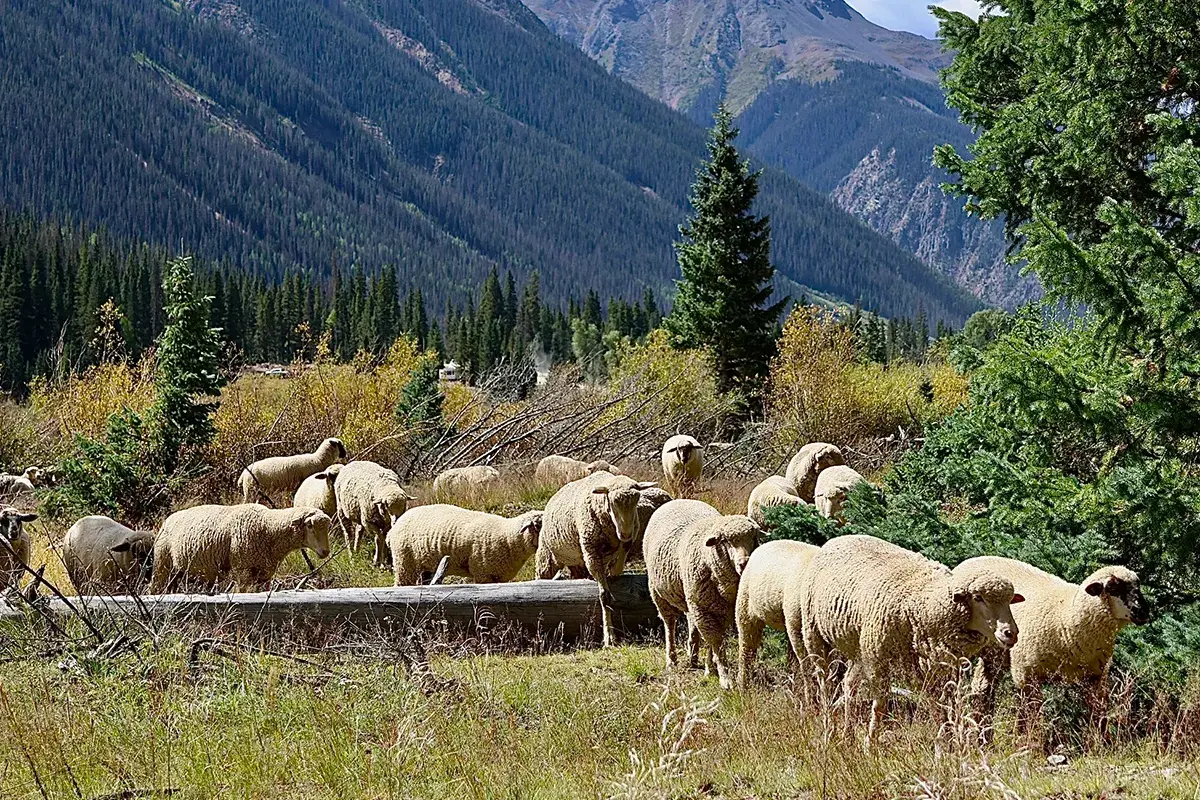
She enjoys being out on the range with her sheep, who graze on private and public lands in Eagle County from mid-May to early November, before returning to Loma. That’s where the sheep feed on the “aftermath” — foliage left over from local farmers’ hay harvest — for the winter. In March, the ewes are brought to the desert to graze on both public and private lands near Cisco, Utah, for the next two or three months — depending on available water and vegetation.
Like her sheepherders, Hansmire stays in a “sheep camp” — a small camper outfitted with a woodstove, bed, small sink, and a place to sit. She saddles up her horse in the mornings and, accompanied by border collies, rides out to monitor the land, checking to see where her sheep have grazed, and where they are heading next. “I love sheep camps, the culture, the simplicity,” she said. She spends six months of the year at her house in Loma; it is where she “hangs her hat,” she said.
Etchart’s father, Martin Etchart, was a French Basque sheep rancher who came to the United States in 1947 to herd sheep. He eventually bought into a sheep operation in western Colorado, which his sons Ernie and George, and their families now operate with the help of four to seven farmworkers. The Etcharts also raise Merino sheep, which produce a fine, high-quality, soft wool. “My father looked for years for the best rams he could find,” Ernie said.
Wool prices were strong when Etchart first learned about Shaniko Wool Company. Then came a year of low wool prices, along with a realization that he needed a more consistent market. “As I considered Jeanne’s endeavor, we were doing most of the requirements anyway,” regarding RWS certification, Etchart said. “It was not a big deal to fold in.” Additional recordkeeping and allowing third-party audits seemed a small price to pay to maintain a consistent market every year, Etchart said. “This opens up more opportunities — to have that seal of approval.”
Each of Etchart’s 4,200 sheep nets about 10 pounds of wool for a total of 42,000 pounds of wool after the sheep are sheared in March. Etchart has sold his fleece to Shaniko since 2021.
Although Hansmire already had a buyer for her wool before joining Shaniko, she didn’t like not knowing where her wool ended up. “As much time and care as we give to our ewes, I wanted to know where the wool was going,” she said. “It’s satisfying to know the end use of our wool. Jeanne has really helped us reinvigorate our business. Our wool is really desirable, and Jeanne has added value to our resource.”
In January, at the National Western Stock Show in Denver, Hansmire won the Grand Champion Territory Fleece award for her 20-pound Merino ewe fleece — an honor she’s won repeatedly at the stock show. And she’s not the only one. “Often one of our Shaniko Wool members win top fleece honors at the National Western show,” she said.
Hansmire is proud of the work they do raising sheep, caring for the land, and harvesting wool, which she calls “a wonder fiber.” Unlike synthetic fibers, wool doesn’t contain petroleum products. “I really like wool,” she says. “It’s not going to stay in the landfill. It will absorb back into the earth. Leave a sweater outside, and it will eventually compost. Wool is fire resistant. It’s warm when it’s wet and cool in the summer.”
Shaniko sells its wool to several brands, including a massive online yarn outlet — knitpicks.com — which prior to the COVID-19 pandemic was all imported yarn, Carver said. “Now you can search ‘high-desert’ yarn and it’s all Shaniko,” she said. “We’re the first and only American yarn offering they have.”
“We’re feeding and clothing America and delivering a net positive impact to nature; there are six years of data to support that. Wool is the best fiber in the world.”
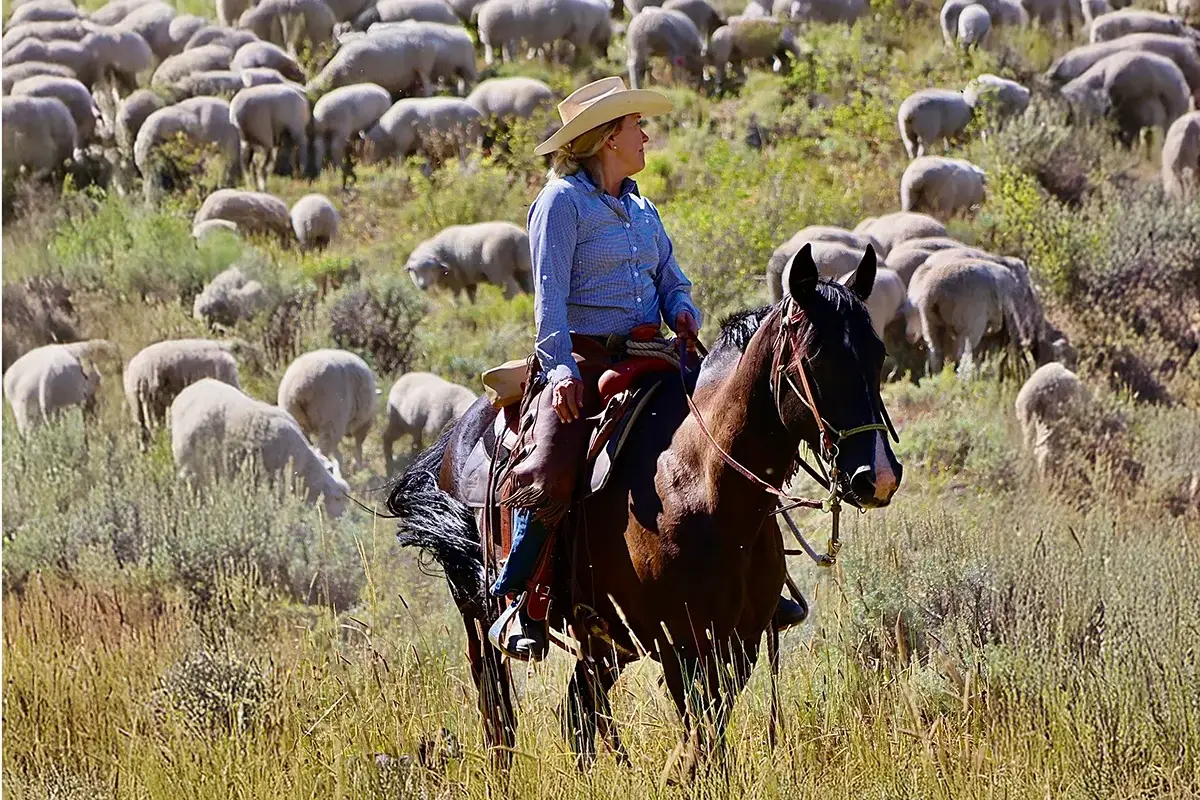
Julie Hansmire of Campbell Hansmire Sheep monitors her flock, enjoying the sheep camp life. Photo courtesy of Shaniko Wool Company
Sharon Sullivan is an award-winning Grand Junction-based journalist. Her work has appeared in Colorado Newsline, The Colorado Sun, The Grand Junction Daily Sentinel, cornerpost.org, and other publications.