


What began in a broom closet of a 146-year-old church in 1992 has now become the lifeblood and soul of the community of Leadville. For more than 34 years, St. George Episcopal Mission’s Community Meals & Pantry has been feeding the hungry both nutritionally and spiritually through committed volunteers, food donations, and a true spirit of hope.
Today, the St. George Community Meals & Pantry serves hot and nutritious meals four days each week, opens its food pantry two days every week, and operates a mobile pantry to distribute food to area residents who have no transportation. It wasn’t always that way.
“When the Climax Mine, the area’s largest employer, shut down in 1992, thousands of people in Leadville and Lake County were left without employment and income,” said Laurel Biedermann, finance and communications manager at St. George Community Meals & Pantry.
Church members sprang into action, using some space inside a broom closet at Leadville’s St. George Episcopal Mission to help feed people in the community who had suddenly nowhere else to turn. “To say that resources were basic is an understatement,” Biedermann recalled. “Furnished with only a rudimentary sink, a few metal shelves, a small workspace, and a refrigerator, that broom closet became the site of the grassroots beginning of what is now the St. George Episcopal Mission Community Meals & Pantry.”
In the early days, volunteers prepared simple meals a couple of times a week, using donated food items cooked in that small janitor’s closet in slow cookers and on hot plates. Times were posted for the meals.
As additional items were donated, area residents could come by once a month and take one bag of items like flour, cheese, sugar, and other essentials to help with the shortfalls. They’d often stay for Bible study.
Several years after the program began, St. George Episcopal Mission member and Community Meals volunteer Susan Fladager initiated a basic remodel of the kitchen to accommodate more clients and volunteers. She had joined the church in 1994 and began volunteering to help prepare community meals.
“The expansion started as a way for us volunteers to be more effective and efficient at preparing meals,” Fladager said. “I’m 5’9″ and my meal prep partner, Ginny Peros, is also tall, and we found leaning down to a table to prepare food uncomfortable. Someone told me about the grant — maybe from the diocese — so it seemed like a good way to get help.”
“A local contractor gave us a good price, and it made sense that if a countertop was being built, cabinets could be built above them without taking up any more space. Shortly after the kitchen area was remodeled, a visiting priest/contractor rebuilt and enlarged the bathroom and added a shower,” Fladager recalled.
Pat Motika began going to meals in 2000, and she quickly started volunteering. “I go to meals because I like to help, and I found that people who are in need are very helpful and thankful for what they have,” Motika said. “When I first came to St. George I felt a sense of belonging, being loved and cared for. That’s why I’m still here.”

“St. George is a place for people to come with no judgment about economic status,” Motika continued. “For many of us, the program is about much more than the food,” she said.
As the programs grew, other modifications at the campus took place. The parish hall was converted to a dining room, and part of the sanctuary provided storage for food bank items. Businesses such as Safeway and a local bakery began to donate food. The number of volunteers also increased with many of the people who used the program helping clean up after a meal or even assisting in the kitchen.
Fladager remembers a client named Bill from the 1990s who attended meals. “After every meal, he stayed to help clean up and wash floors for us when few others did so,” she said. “He stayed with us [at Community Meals] until his death from the result of drug use. But I found out what a wonderful person he was and it helped me discover unquestioned love for my fellow man.”
In 2010, Luz Escalera joined The Community Meals & Pantry as a cook; she learned about the program from a friend of hers who also cooked there. For the past seven years as food supervisor, she has overseen operations of the food pantry, developed the menus and meals for community lunches, and supervised the volunteers who help prepare the meals and serve community members who dine there. She is St. George’s only full-time employee.
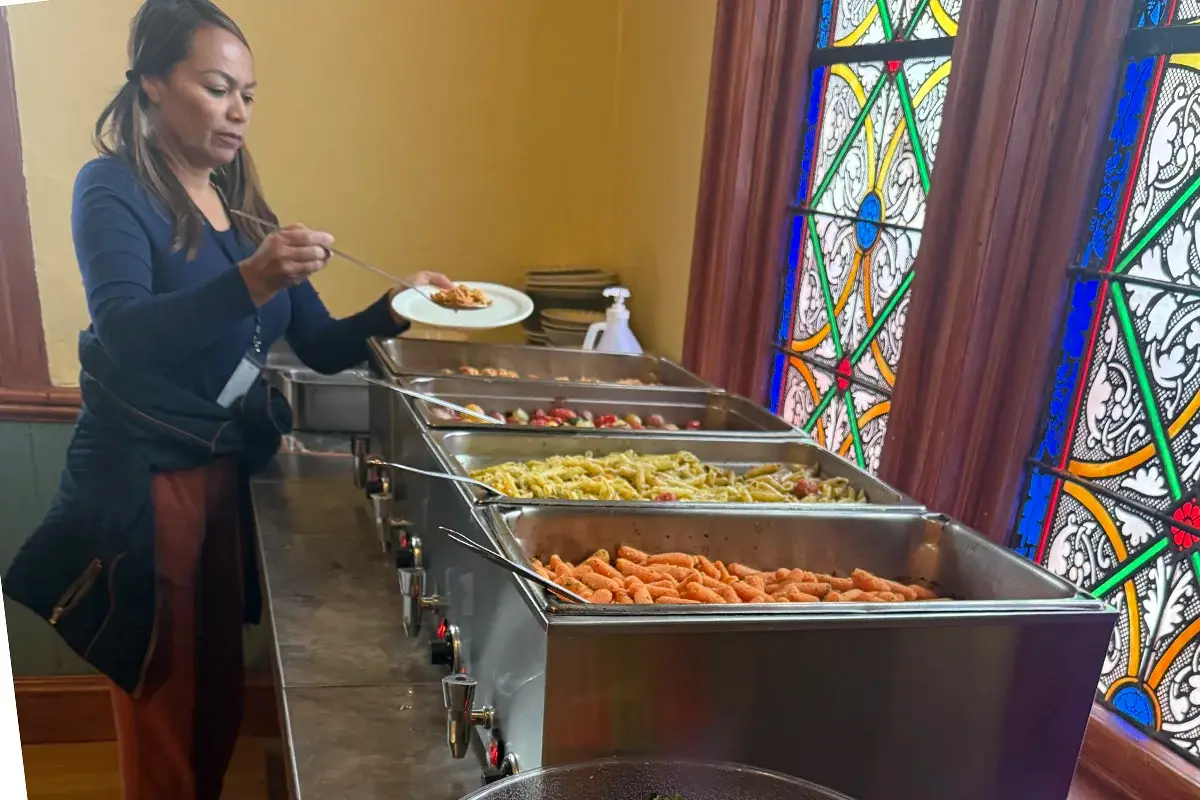
Since she joined the program, Escalera has seen several changes. Perhaps the most significant was the addition of a commercial kitchen where she and her volunteers prepare meals. “We now serve four community meals each week and can have as few as 20 people in the winter or as many as 80 in the summer,” Escalera said. “We need to be sure to cook enough for everyone, so we must be flexible.”
Escalera noted that approximately 61% of participants are Hispanic and don’t speak much English. “I’m happy that I am bilingual so that we can communicate with them,” she said.
The coronavirus pandemic was a critical turning point for the mission. The pandemic revealed the level of food insecurity in Leadville and Lake County, estimated at more than 11%, as reported by Feeding America. Plus, Leadville had only one grocery store to serve more than 8,000 Lake County residents. Lake County is a USDA-designated food desert because of its absence of resources. In 2020, many locals didn’t qualify for the traditional means of assistance, including meeting their food needs. That same year, a modestly priced meal cost 27% more than SNAP benefits.
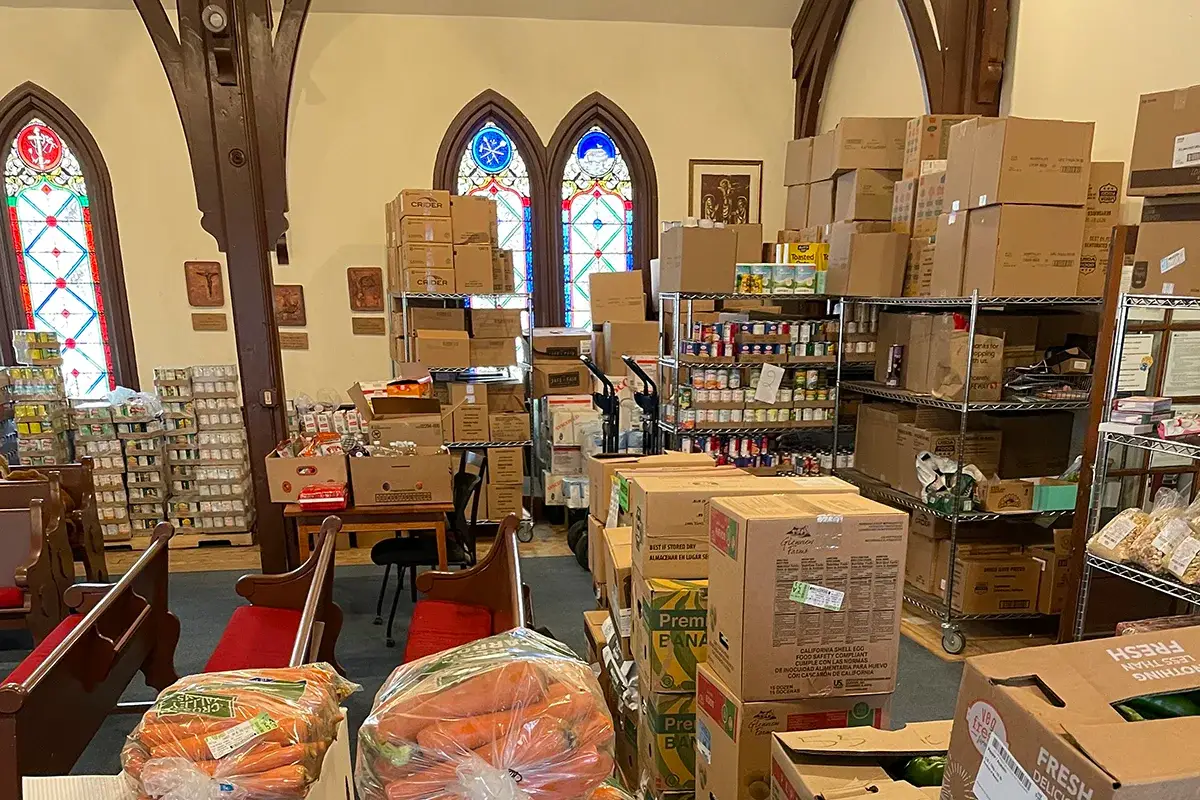
St. George Episcopal Mission worked with local organizations to begin a large food pantry housed in the church sanctuary to meet the rising community needs. The pandemic prevented indoor worship, but the sanctuary was put to good use. Potatoes covered the altar and boxes of other vegetables were displayed on multiple tables.
“The donated food took up a significant part of the sanctuary. Pallets and racks of food were bathed in light through the historic stained-glass windows installed when the church was built in 1880,” Biedermann said. “Worship services are held for members in a circle amidst the food every Sunday, a reminder of the work that the members and volunteers of The Community Meals & Pantry are doing for the community and nearby towns.”
Community partners signed on to help support the program, including Safeway, Target, and Whole Foods. However, many of the food donations had to be picked up in Summit County — about 40 miles each way — and brought back to St. George. This required not only vehicles to transport the food but volunteers to regularly drive the trucks, unload and inventory the donations, and organize them to be ready for the people coming in each week for regular food pickups.
In 2022, a major kitchen remodel was completed, thanks to a generous grant from the Gates Family Foundation. This remodel included stainless surfaces, commercial ovens, sanitizing sinks, and a walk-in refrigerator. The remodel made it easier to prepare meals in greater quantities.
As Motika says, people associated with The Community Meals & Pantry see and experience the program as much more than a way to feed the hungry. It’s a way to give back.
Pastor Melissa Earley brings the essence of the program full circle. “We are an Episcopal Church. We worship every Sunday at 5 p.m.,” she said. “Our food work isn’t separate from our spiritual work. It is our spiritual work.”
“At St. George it’s not an ‘us and them.’ It’s not ‘us who go to church and them who come to the meals.’ All of us are part of the St. George community. We’re not a church where worship is the main show and helping the community is a side hustle,” she continued. “It’s as important to me to have someone come to lunch as it is to worship and to volunteer in the food pantry as it is to attend a Bible study.”
Pastor Earley and other church members eat regularly at the community meals. “We want everyone to come to lunch. We build community by sharing food. It’s great to see the mayor of Leadville talking with the person who lives in the woods and to see the young man recently out of jail helping older adults who are having computer issues.”
In addition to getting to know people, Pastor Earley has visited people in the hospital, officiated at memorial services, and performed weddings for the people who come to the meals and food pantry.
The people who eat at the meals and get food from the food pantry are also program volunteers. “If you were to show up at St. George on a pantry day, you would see people getting to choose what they take. We call it shopping,” Pastor Earley explained. “You’d see people at the pantry helping out in lots of ways — they’re carrying each other’s babies, and teenagers are vacuuming the floor or carrying food out to cars for older adults. Recently, someone who had just shopped was cleaning out the kitchen grease traps.”
“Here, everyone has the dignity and agency of choice and the ability to give back to the community,” Pastor Earley said. “At St. George, we create a culture of mutuality. You can’t tell the difference between givers and receivers, and you shouldn’t try. We all need to give. We all need to receive.”
By Pamela A. Keene
Pamela A. Keene writes lifestyle, gardening, travel, health care, and consumer articles. She is an avid gardener, has visited seven continents, and is an award-winning photographer.