
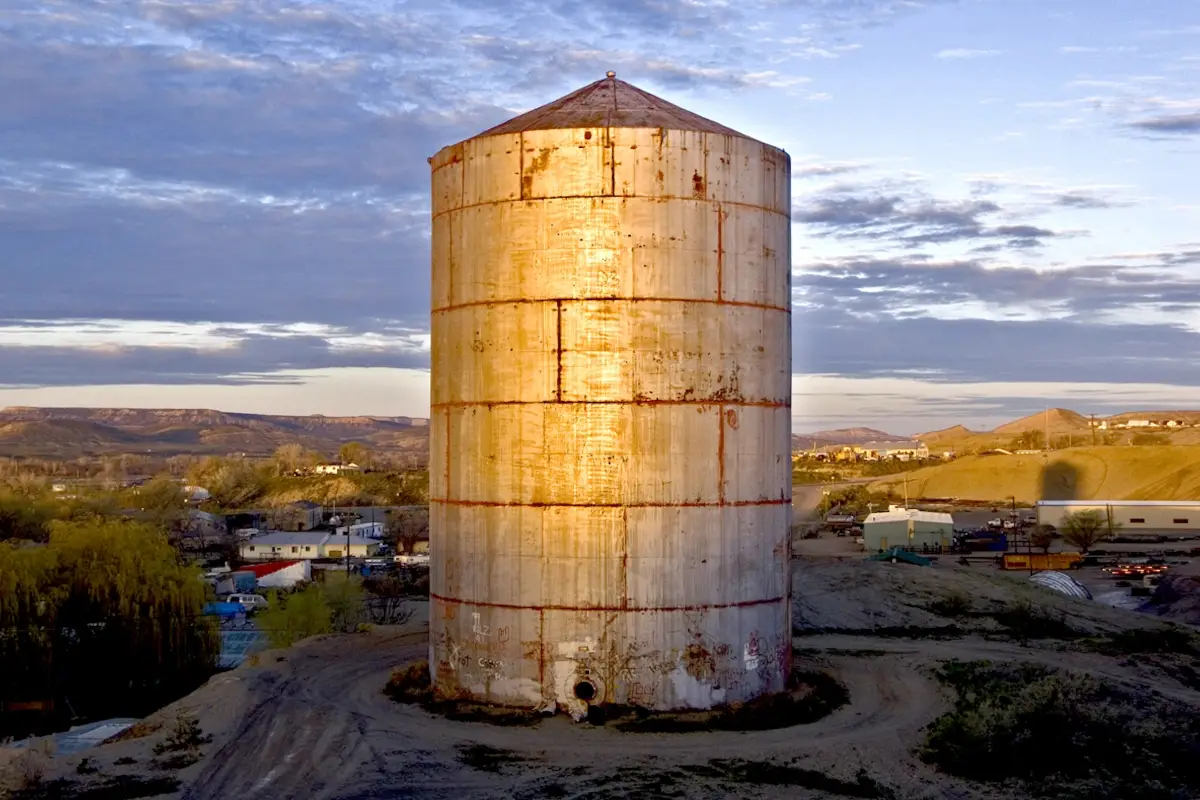
The Tank Center for Sonic Arts ages with acoustical grace
Thank the Tank. That’s the song being sung by the town of Rangely, Colorado, about its odd but acoustically awesome recording studio and performance venue, which celebrated its 10th official season last year after first being discovered 50 years ago.
Drive by the aptly named giant steel cylinder, and it looks like any other empty, seven-story water tank in rural Colorado, surrounded by sagebrush and low-lying hills. But closer inspection reveals an acoustic anomaly. Built in 1940 as a water-processing tank for the Rio Grande Railroad’s steam engines, the Corten steel cylinder was moved to Rangely in the 1960s as a fire-suppression system for the local utility company. That idea failed when the underlying shale proved to be a poor foundation, so the cylinder languished empty for years.
But then something magical happened.
That same unsupportive foundation bowed the cylinder’s floor into a gentle parabola, which, combined with its 65-foot convex roof and steel walls, gives it amazing acoustical resonance. Indeed, some reverberations inside can last up to 40 seconds. “The Tank is a weird industrial acoustical accident,” said Friends of The Tank Executive Director James Paul. “Its installation produced a swirling, sustained, world-class reverberation.”
Those reverberations began making more than sound waves when composer and sound artist Bruce Odland stumbled upon them in 1976. Odland was touring Colorado, creating a sonic collage when, while recording ambient sounds outside of Rangely, two locals took him to the Tank. Odland recognized its uniqueness right away. “I’d never heard anything like it,” he said at the time. “I’d never heard a sound last that long, with these dizzyingly beautiful reverberation effects.”
If its sounds echoed, word of the venue also quickly reverberated around the music community. Odland began inviting sound artists and musicians there to perform and record, and the Tank’s reputation quickly grew. The informal gatherings and recording sessions lasted until 2013, when the Tank’s owner put it up for sale as scrap. Wanting to preserve its unique sound and recording characteristics, a group of musicians, community members, government officials, local businesses, and other volunteers banded together to form nonprofit Friends of The Tank to try and save it.
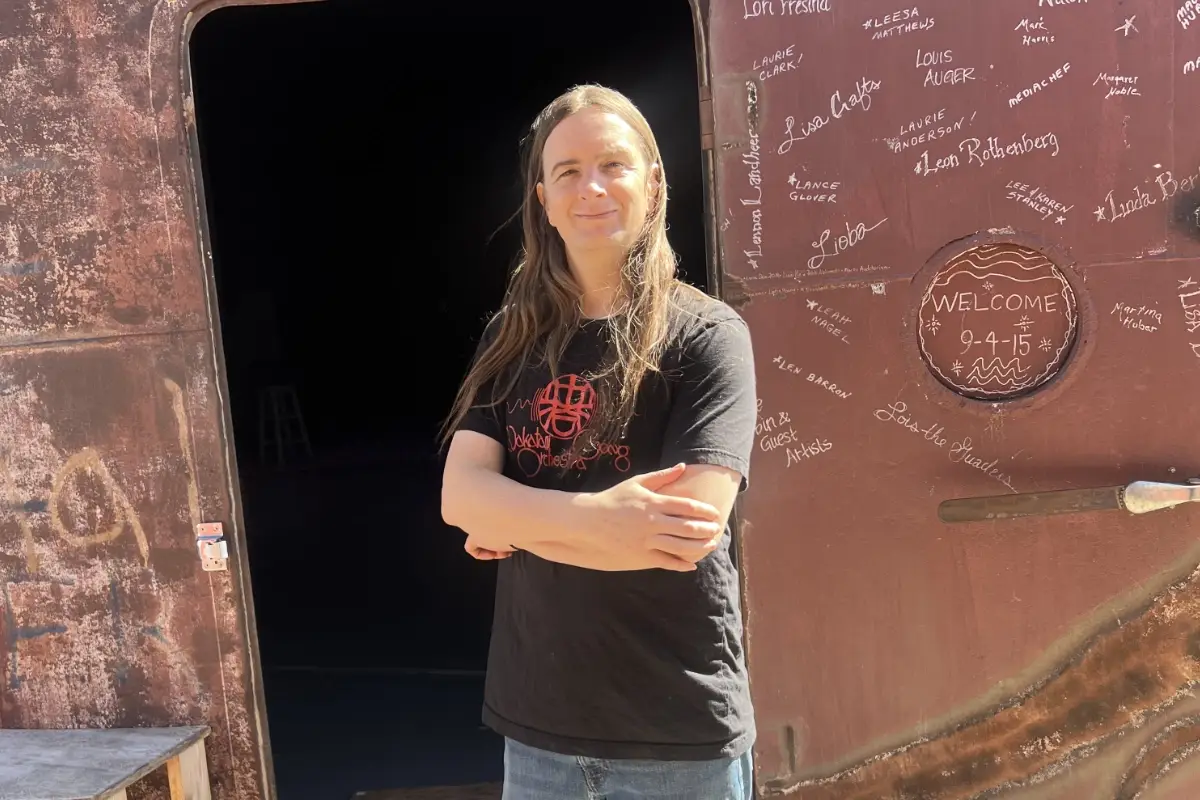
Kickstarter campaigns and other donations helped them secure the Tank and its land; install electrical service, ventilation, and lighting, and even a fiber-optic network for livestreaming; build an access road and parking lot; cut a full-size door to provide legally required access and to accommodate large instruments; and seal and paint the floor and walls, build a deck, install safety fencing, and add sanitary facilities. The group also petitioned for a change-of-use permit from storage facility to public assembly hall, eventually receiving a certificate of occupancy, and later funded an executive director position and other staff. A grant from the Boettcher Foundation helped them purchase a state-of-the-art recording studio, housed in an adjacent shipping container, and the Tank Center for Sonic Arts opened in 2015 as an official recording and performance venue.
As more and more musicians came to see what all the hoopla was about, word got out about the Tank as a performance venue. It even garnered reviews from the New Yorker and the LA Times. “Forget Carnegie Hall. Musicians rush to rural Colorado to play The Tank,” read the headline in the Times. “Music has never seemed closer to nature … one road to the musical future now runs through Rangely,” wrote Alex Ross in the New Yorker.
“When a performer first plays there, there’s usually a pause as they try to reestablish their habitual style, then they are stopped as they realize the whole place is singing back at them,” said Paul, adding they’ve now used the Tank to host a range of performances, from medieval songs to Native American flutes and experimental synthesizers. “Then comes the revelation that the instrument is actually the whole structure, and that playing there means slowing down, being responsive, and really listening. Many performers have told us that their way of playing changed for good after they heard themselves play there.”
Now a fully equipped recording venue and concert site, which seats 49 people inside and hundreds more outside, last year the Tank Center for Sonic Arts celebrated its official 10th anniversary, drawing such artists as Raven Chacon, Alan Mackwell, and even an orchestra playing Beethoven’s String Quartet No. 14. Last year alone, 10 different albums were released with music recorded at the Tank.
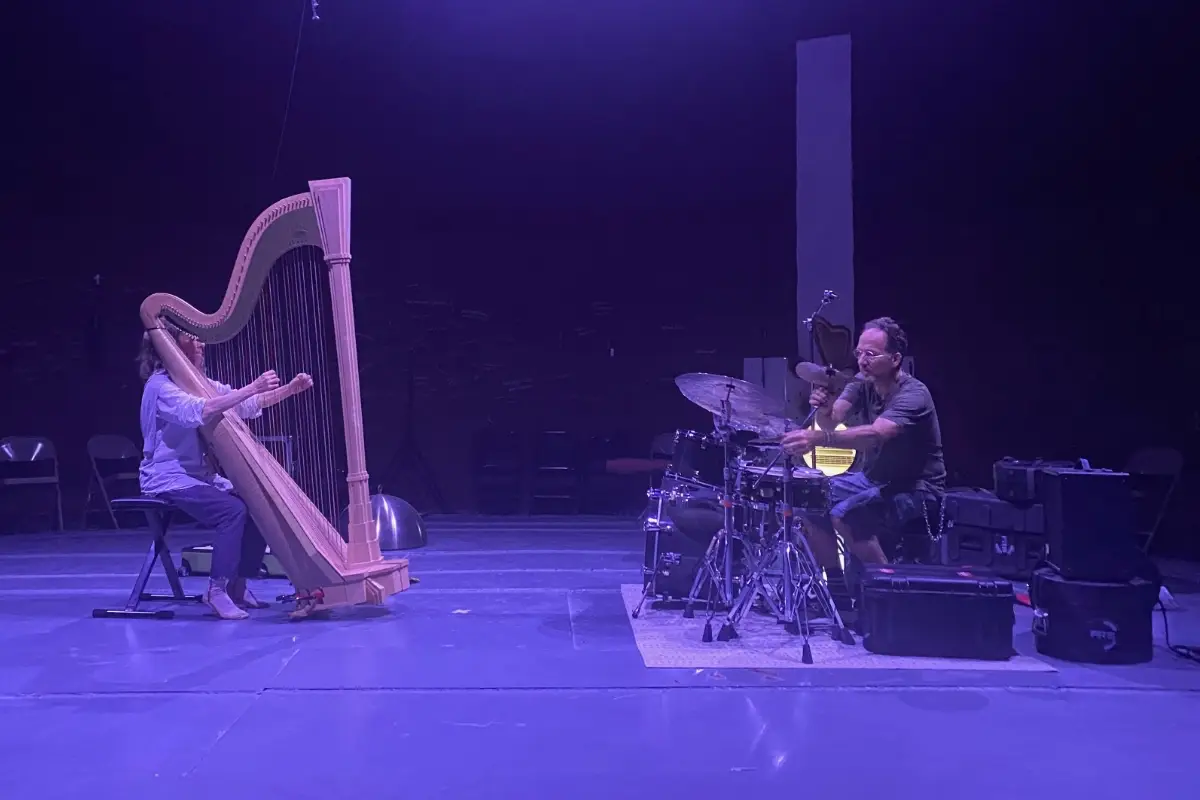
Perhaps no one can attest to its unique sound better than these musicians who have played there. “Playing there is truly sublime — it’s both grounding and otherworldly simultaneously,” said flutist, synthesist, and composer Todd Barton, who has played in the Tank several times. “Time and space stretch out, and one’s listening discovers the beauty of slowing down. A single sound can be explored and expanded into a revelation.”
It’s the type of reverberation, he added, that you’d expect to find in a place like the Taj Mahal, not in the arid steppes of northwestern Colorado. And the Taj Mahal, he said, only has 28 seconds of reverb time.
“The Tank has 40 seconds of reverberation,” he continued. “The sound spins, spirals upward, and returns to you. You literally can play chords with yourself. For such a seemingly small, tall space, the long reverberation time is surreal.” This also owes itself to Barton’s particular instrument of choice — the Japanese bamboo flute, or shakuhachi. “It has an extremely wide range of timbres and special effects,” he said, adding that a loud blast from it ignites the Tank, with its “decaying component sounds unfolding endlessly.”
“Its soft, whisper tones also get amplified and dance around inside it.” (Listen for yourself here: toddbarton.bandcamp.com/album/resonances.)
MEETING THE TANK IN PERSON
In early March 2026, I stop in to experience the Tank’s remarkable resonance myself. Joining me is my brother-in-law, Nino, who plays in a band called the Midnight Sun Zombies up in Alaska. “It’ll be fun,” I cajole him about the journey. “Call it a road trip for reverberations.” With that, we head west on U.S. Highway 40, turn left on Colorado State Highway 64, and then left again on County Road 46. That’s when we first see it, rising above the barren, shale-filled hills like something out of Hollywood’s 2001: A Space Odyssey. Mind you, it’s nothing fancy (most giant metal tanks aren’t). Its rusted silver steel matches both the surrounding shale hills on one side and a transformer station on the other. Around its base, decades-old graffiti lines it as high as vandals could reach. An abandoned matching silver trailer camper rests somewhat askew in a nearby gully, towed there by Odland to house visiting artists. But no one’s likely ventured inside it for decades.
Meeting us outside is Mike Van Wagoner, the venue’s lead sound engineer, or “Tank tech.” His musician dad stumbled upon it in 2010 while working in the nearby oil fields, played inside it a couple of times, and then showed it to him. The only other employee besides Paul and Van Wagoner is assistant director and sound engineer Samantha Wade, whose grandmother used to have the key to let visiting musicians inside.
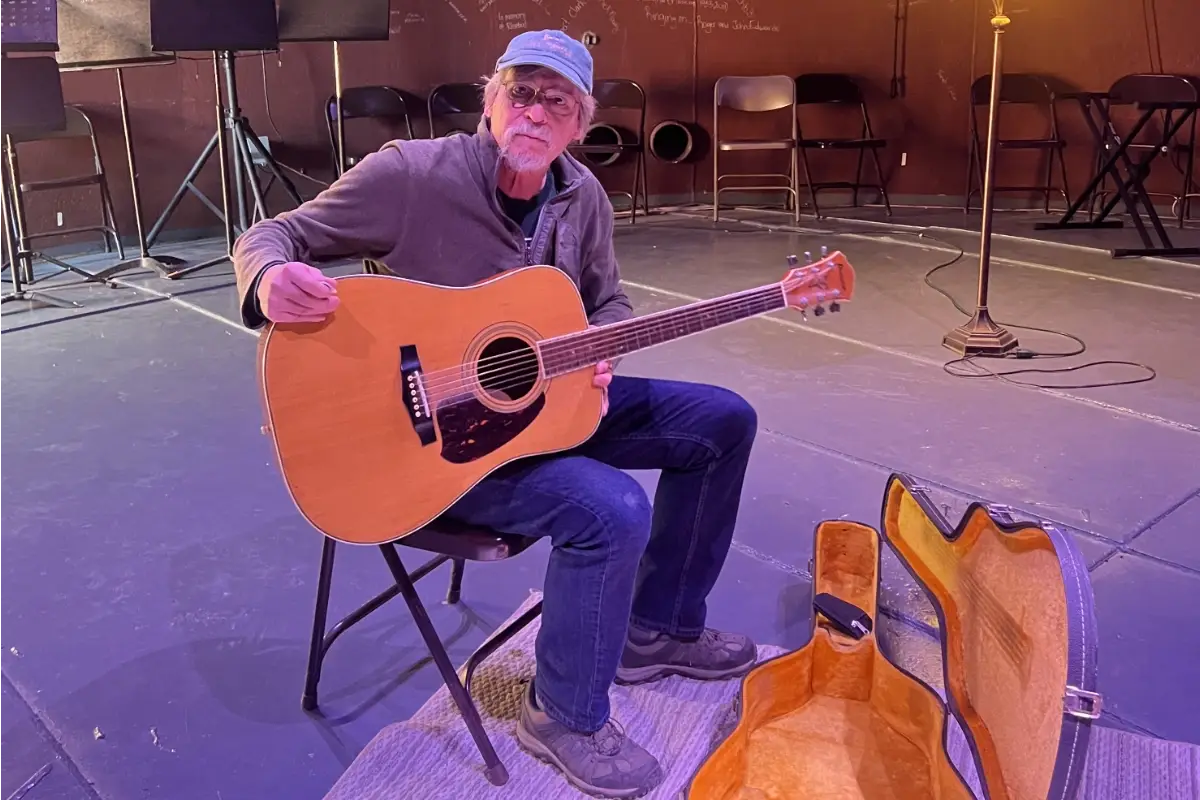
Van Wagoner shows us a recording panel in a tiny side office, fashioned from a shipping container, before we follow him through a giant door that was cut through the Tank’s metal wall in 2014. Before that, he says, the only way in was through a tiny round hole barely two feet in diameter — an old water vent they now call the portal — along its far wall, an opening that could barely fit a guitar. As soon as we step inside, I notice that even our steps reverberate on the Tank’s blue metal floor. Metal folding chairs line its circular perimeter, whose wall is adorned with the silver signatures of donors who contributed to the two Kickstarter campaigns that helped launch its reverberating reincarnation. Microphones dangle from its towering ceiling, while music stands and a variety of instruments lie scattered about the near wall — including bongo drums, xylophones, recorders, flutes, maracas, and Van Wagoner’s favorite, a giant “hand pan,” or metal dome with cavitations you can bang on to elicit different echoing tones. We try them all, quickly falling under the Tank’s spell. Then Nino grabs his guitar, first ripping off a couple of Grateful Dead licks before settling into Pink Floyd’s “Brain Damage.”
That’s the money song. I can almost hear the laughs echoing from the lyric “The lunatic is in the hall,” a classic off Floyd’s Dark Side of the Moon album. We learn that too many notes tend to overlap each other, but long, drawn-out melodies like that, or from Nakai, Barton, or even Van Wagoner’s flutes, bring out the Tank’s best. You can’t help but listen in amazement, spellbound by the sound.
I look at my phone for service, hoping to FaceTime a musician friend back home, but the signal has vanished like the echoes. Van Wagoner said someone tried to film with a drone inside once, but there wasn’t even a Bluetooth signal. “As soon as you cross the barrier, you lose all connection,” he said. “It’s like a giant Faraday cage. You’re completely unplugged.” In a way, that seems like a good thing: Reverberations without any help from technology. He added that he’s been inside the Tank and heard its resonance in rain and even hailstorms but that he doesn’t push his luck. “I try not to go inside it when there’s lightning,” he said.
As we leave, I hit the interior wall with a big rubber mallet. The entire interior vibrates, as if it’s giving us a final farewell. The amplification sounds like a giant thunderstorm — one you wouldn’t want to witness from inside.
KEEPING UP WITH THE TIMES
Realizing Rangely is off the beaten path for most music fans, the Tank’s organizers have broadened its scope to reach other locations. If people can’t come and experience it for themselves, bring it to them. During the pandemic, they started a program letting musicians record and listen to the Tank remotely. They play at their own studios, with speakers inside the Tank letting them hear it as if they were there. “Now artists all over the world are playing in the Tank, without ever leaving their studios,” said Paul, adding they’ve developed collaborations with venues around the country — such as Boulder’s B2 campus — where the spatial acoustics of the Tank can be reproduced and recorded. “Audiences far from Rangely can now have the Tank experience.”
A show this summer further illustrates how organizers are branching out to showcase the Tank. Musicians Neal Johnson and Alan Watts plan to use arcane electronic devices to bring “it to life as a single instrument, summoning the Tank’s own voice to tell a tale of its past, present, and future.” Their “Ferromancy” show will feature human-controlled music technology (MIDI and OSC) that is programmed to trigger mechanical parts to strike — or “play” — the Tank’s walls. Magnetically affixed to the steel walls in a hemispheric array, transducers will disseminate its sonic energy and structural vibrations across multiple audio channels, so the whole thing becomes a giant speaker.
The Tank is filling up with other events as well, kicking off with its Summer Solstice Festival June 19-21 and an array of other “resonant” music, from ethereal to medieval. Many concerts are free — including weekly Saturday sessions from 9 a.m. to 1 p.m. Locals have also begun to embrace it. A local pipeline company donated raw materials that have been converted into percussion instruments, Giovanni’s Italian Grill has created a special Tank pizza, and a group of residents recorded a Christmas CD there called Rangely A’Caroling at the Tank. On Saturdays, you may hear locals singing “Amazing Grace” inside. “In the early days, locals didn’t really understand it,” Van Wagoner said, adding that plans are also in store to build a natural amphitheater and stage outside. “They sort of thought, ‘Oh, it’s just a bunch of hippies.’ But now they’re pretty accepting of it.”
If the music inside sounds sacred — words like “meditative,” “calm,” and “emotional” have all been used to describe it — in large part, it is. Adding to its mystique, the Tank is located on the traditional territory of the Ute Nation, whose members also herald its uniqueness and use it for ceremonies and other gatherings. From Native Americans and avant-garde electronic musicians to flutists like Nakai and guitarists like Nino, it’s truly become a haven, of sorts, for the general public, local music community, and visiting artists — and even curious visitors like me, who come to hum, bang, sing, strum, and, most importantly, listen.
“Its resonance just enhances any voice or instrument,” Paul said. “It’s way more powerful than people expect. I’ve seen groups of strangers moved to tears inside just by singing and suddenly sounding like a heavenly choir.”
Eugene Buchanan is an award-winning author whose work has been published in The New York Times, Men’s Journal, Outside, National Geographic Adventure, and more. His new book, Yampa Yearnings, was released in December 2025. He lives in Steamboat Springs.
Photos courtesy of Eugene Buchanan, John Paul, and Kim Keith.