
Community, grassroots radio stations offer hyperlocal content, no commercials
You never know what you’ll find when you listen to KAFM Community Radio’s Kitchen Sink program aired Fridays at noon. Listeners call in to the radio station seeking to sell, barter, or purchase items; promote yard sales; or talk about special events and other matters. And while no one yet has offered up a kitchen sink, a set of kitchen cabinets have changed hands.
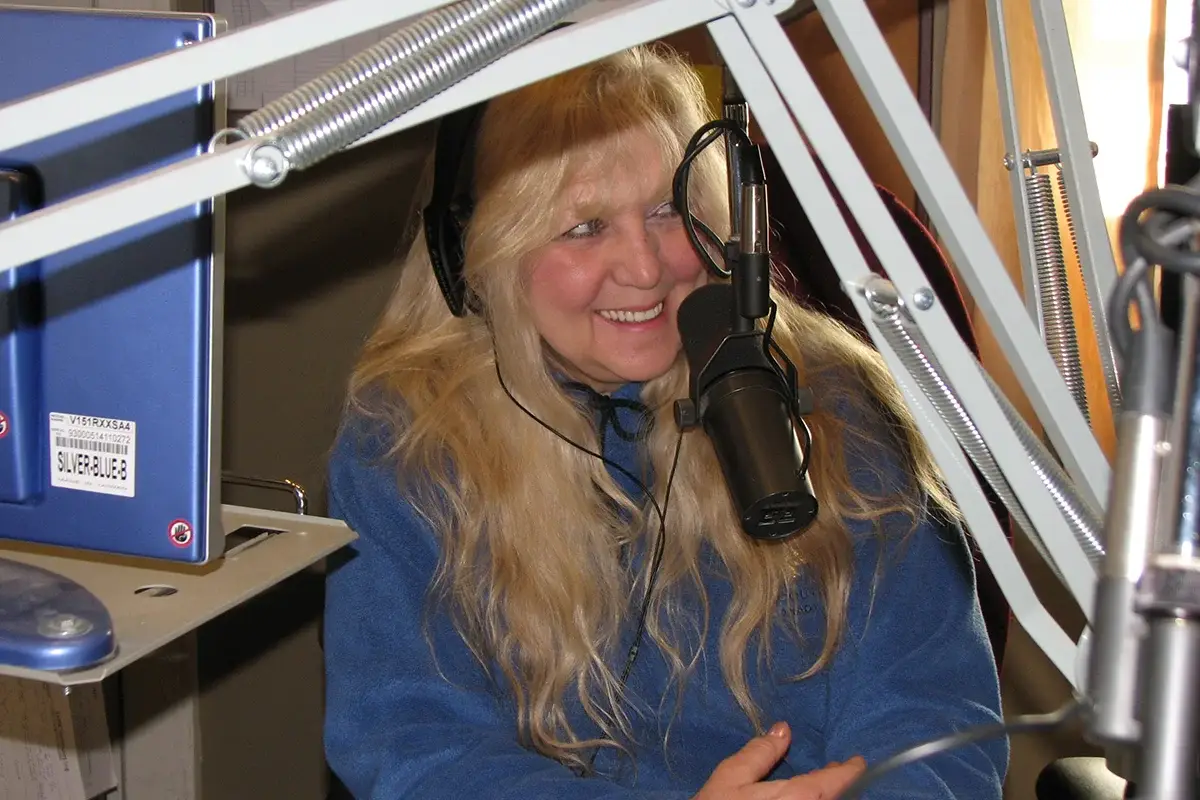
“We incorporate everything — that’s why we call it the Kitchen Sink,” said co-host Suzi Radosevich (known on air as Suzi Creme Cheeze).
A few years ago, a man called in to say he was looking for a girlfriend, Radosevich recalled. “We actually had someone respond to that; she called in later during the program,” Radosevich said. “We exchanged their numbers. Two or three months later the couple called in to say they were together and it was our fault.” They ended up marrying.
Colorado’s Western Slope is home to a number of locally owned and operated noncommercial community radio stations — including KVNF in Paonia, KOTO in Telluride, KSJD in Cortez, KHEN in Salida, KAJX in Aspen, and KAFM in Grand Junction. Community radio stations also broadcast from Durango, Crested Butte, Ignacio, and elsewhere — and while there’s no formal definition of what makes a station “community radio,” they tend to be independent, staffed with volunteer DJs, and focused on local public affairs. Additionally, community stations often offer a wide variety of music genres and report local news; although KAFM just plays music, and KAJX airs only news, except in the summer when the station broadcasts the Sunday afternoon concert live each week from the Aspen Music Festival.
At KVNF Mountain Grown Community Radio in Paonia, listeners tune in — depending on the hour and day — to bluegrass, rock ‘n’ roll, roots, jazz, punk rock, Americana, country, new age, or classical music. A children’s music and story time show, Pot of Gold, is on Saturday mornings, and a Native American music program airs Sunday afternoons.
“Most content originates here and is run by volunteers,” said KVNF General Manager Ashley Krest. “That’s the community model we operate on.”
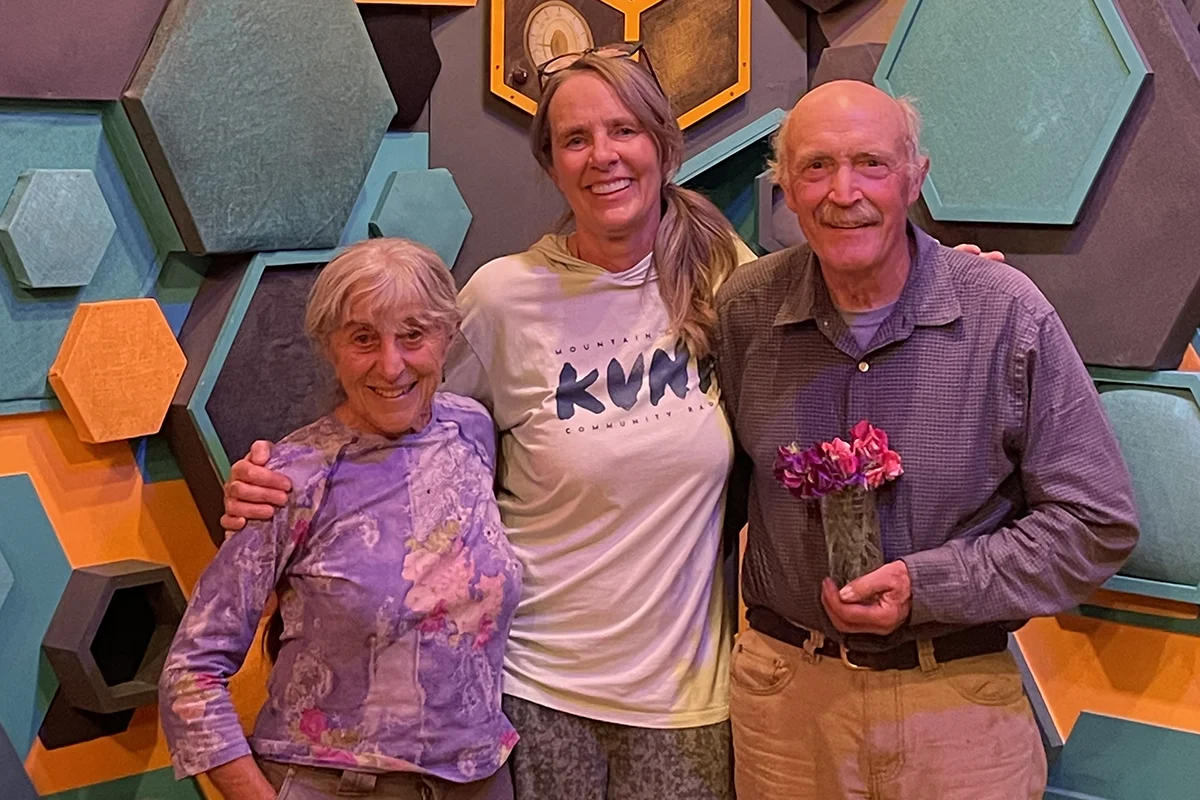
As the Worm Turns is a popular KVNF show hosted by Jill Spears, featuring local organic gardening experts Lance Swigart and Lulu Volckhausen. The trio interviews guests, shares stories, and answers call-in gardening questions. “We venture out of the studio and spend time with local farmers and gardeners touring their plots and land and then bring those sounds and conversations to the listeners,” Spears said.
Swigart is known regionally for growing 90% of his food from seed he’s saved. He ruefully remembers advising listeners to talk to “old-time gardeners in your neighborhood” for gardening ideas, then realized, “That’s us — we’re old-time gardeners.”
Since it began broadcasting 15 years ago, As the Worm Turns has acquired a loyal following, with a new group of listeners tuning in each year. “It keeps growing,” Swigart said. The program airs every Wednesday, from 5-6 p.m.
Music and other types of shows reflect the interests of the volunteer programmers and the communities they serve.
In Salida, at KHEN Free Range Radio, a local woman with a passion for tango dancing curates a show featuring tango music. A program titled Bacon, Lubbock and Tomato Sandwich is inspired by the music originating from Lubbock, Texas — songs by the legendary late singer-songwriter Guy Clark, for example. Another volunteer DJ plays recordings of live music performances in Salida.
A Salida resident who’s originally from Kurdistan hosts a program featuring Kurdish music. Before he became a volunteer programmer — DJ Rama — KHEN staff had interviewed him for its We Are Chaffee podcast. Rama talked about growing up in Turkey where Kurdish music was banned, recalled KHEN Executive Director Lisa Ledwith. “We’re here for anyone in Chaffee County,” Ledwith said.
HYPERLOCAL NEWS
Reporting on school board and city council meetings plus other local happenings is a priority for most Colorado community radio stations. Many stations also carry syndicated national and international news from organizations like National Public Radio and the BBC.
Additionally, community radio serves as an important source for emergency alerts and up-to-date information regarding road closures, bear sightings, and wildfire evacuation notices.
“Emergency preparedness is a huge part of our service,” said Breeze Richardson, executive director of Aspen Public Radio, an independently owned and operated station serving the Roaring Fork Valley. “We can stay on-air during fire evacuations via generators and propane tanks.”
Unlike other community stations, Aspen Public Radio, with primary FM frequencies of 91.5 KAJX in Aspen and 88.9 KCJX in Carbondale, does not typically broadcast music, only news and information.
In addition to its daily award-winning local news service, the station launched a new initiative in March 2025, called Women’s Desk, to focus on women’s voices by “bringing their perspectives and experiences to our local reporting efforts,” Richardson said.
In Paonia, KVNF’s award-winning Regional Newscast is aired twice a day for 10 minutes. “It’s not long, but it’s certainly important to people; it’s an anchor to what’s happening,” said Krest. “Otherwise we’re in a news desert for daily news that’s not television.”
While volunteer DJs play music throughout the week, KSJD radio in Cortez employs a full-time news director and a half-time reporter to cover municipal government, elections, crime, and other issues. Its Farm News and Views program has aired for 20 years, with host Bob Bragg spotlighting the local ag community as a lens for exploring important ag issues like food systems, land use, water, and drought, said Tom Yoder, executive director of KSJD. “It’s an informative way for people to learn what’s going on locally and globally,” he said.
In the tiny town of Telluride, KOTO has prioritized its local news coverage since day one, said KOTO Executive Director Cara Pallone.
KOTO was also the main hub for information during the COVID-19 pandemic. “We were considered essential workers and we stayed on the air,” Pallone said. “We had the most up-to-date information from city and state officials. We were the crisis communications headquarters for COVID. We are, at our core, an emergency alert system.”
Telluride is renowned for its various music festivals held in Town Park. KOTO simulcasts Telluride’s annual bluegrass and jazz music festivals on site so that residents can listen to the concerts from home.
“We look at it as a service to those who have to work or can’t afford the tickets,” Pallone said. “People can listen from their porches from anywhere in the world [by streaming]. It’s an amazing service.”
Community radio stations also share regional stories with one another. Rocky Mountain Community Radio is a volunteer collaborative coalition of 21 noncommercial radio stations in Colorado, New Mexico, Utah, and Wyoming (17 are in Colorado), which has been sharing content for more than 40 years. Each station reflects the unique and diverse nature of their own community through local reporting, culturally relevant music, and public affairs programming, according to its website.
“We [RMCR] employ a managing editor and share content with one another,” said Richardson, who, in addition to directing Aspen Public Radio, is president of the coalition. “We jointly employ a full-time climate reporter.”
Grand Junction’s KAFM chose not to broadcast news programs, focusing instead on music and promoting local nonprofits, when it was established in 1999, said KAFM Executive Director Betty Ries. “It was mostly to set themselves apart,” since syndicated news programs like NPR — for which stations pay to subscribe — were already available at other stations, she said.
“Music tends to bring us all together,” she said.
Ries previously worked at a Denver network that supplied country music and oldies programming to various radio stations. After moving to Grand Junction, she was fascinated to discover KAFM’s programming model, which emphasizes new artists and a wide range of music.
“Most [commercial] stations play one genre,” Ries said. “Here, it’s different all the time. I had not seen that before. It’s what I imagined radio was supposed to be. KAFM is the only radio station in Grand Junction where you can listen to jazz or Celtic music plus other genres depending on the time of day.”
NO COMMERCIALS
Nonprofit radio stations fund their operations through grants, membership drives, and underwriting by local businesses. The Corporation for Public Broadcasting was defunded last year, so community and public stations lost a significant portion of their funding.
Community stations in Colorado are hoping to make up some of that loss through increased listenership and underwriting from local businesses.
“Business underwriting signals to listeners that this local business supports the mission of community broadcasting,” said Serah Mead, director of member engagement with the National Federation of Community Broadcasters. “Some companies underwrite simply because they care about community radio; others recognize a lot of people listen and they want them to learn about their business.”
In May, Colorado lawmakers passed a state budget that included a footnote requiring state agencies that receive appropriations for marketing, advertising, and public outreach prioritize spending the appropriated money with Colorado media outlets, which could help bolster local radio stations.
“Less and less media is locally based, or only publishes once a week,” Yoder said. “We have that amazing ability to get on the air waves — at a moment’s notice — to talk about evacuation notices, a road closure, wildfires. One of the biggest values of community radio is that it’s locally produced, owned, and operated. We keep our eyes and ears open on what’s going on in the community.”
Tune in to a community station near you or stream from anywhere in the world to find out what’s happening in Colorado.
DSC01758- Grand Junction’s KAFM Music Director Guy Curwick. Photo by Tanya Marchun
KS Suzi – ice 002- Grand Junction’s KAFM Kitchen Sink program co-host Suzi Radosevich. Photo courtesy of KAFM
Lulu-jill-lance as the worm turns – Paonia’s KVNF “As the Worm Turns” program host Jill Spears (center) with local organic gardening experts Lance Swigart and Lulu Volckhausen
Getty Image courtesy of avdyachenko/ iStock / Getty Images Plus
Sharon Sullivan is an award-winning Grand Junction-based journalist. Her work has appeared in Colorado Newsline, The Colorado Sun, The Grand Junction Daily Sentinel, Cornerpost.org, and other publications.